About Jabbar Farshbaf
About Jabbar Farshbaf
Jabbar Farshbaf is an Iranian author, poet, literary researcher, and self-taught painter. His work is rooted in Persian literature, particularly Persian epic, and in his long-standing interest in the relationship between stories, cultural memory, and visual art.
His connection with the stories of Ferdowsi’s Shahnameh began early in life. The stories were part of the oral tradition he experienced growing up, and over time this early connection developed into a deeper engagement with Persian literature, poetry, philosophy, and mysticism.
As a researcher and teacher of Persian literature and poetry, Farshbaf has been particularly interested in finding ways to make classical texts easier to approach without losing their essential meaning. This interest led to the creation of the Shahnameh Projects.
The first major work in this series is Minimal Shahnameh, a bilingual book that presents the complete narrative of Ferdowsi’s Shahnameh through sixty-seven connected stories. Rather than replacing Ferdowsi’s original work, the book provides a clear path into it by removing linguistic complexity, repetition, and secondary details while preserving the continuity of the main narrative.
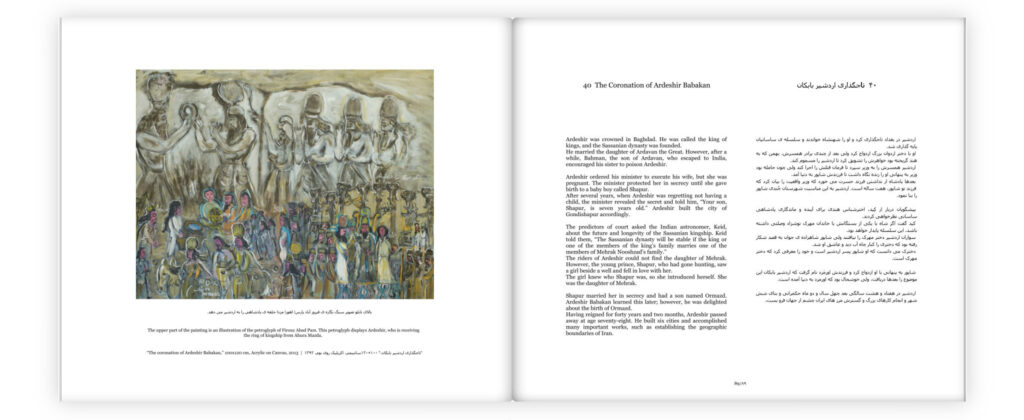
The book is accompanied by sixty-seven original acrylic paintings, each connected to one of its stories. Farshbaf began painting specifically for this project and developed a distinctive visual language through the process. The paintings are not simply illustrations; they are independent visual interpretations of the stories, using bold colours, simplified forms, handwritten names, and narrative compositions to create a dialogue between literature and image.
His research also explores the details that often remain unnoticed within the Shahnameh: names, words, references, and fragments that can reveal forgotten stories, historical traces, and deeper layers of Persian cultural memory.
What artist says
My work has always been rooted in Persian literature, especially in the vast and symbolic world of Ferdowsi’s Shahnameh. Over the years, I kept asking myself a simple question: How can one of the greatest literary works ever written become accessible to more people without losing what makes it meaningful?
I never wanted to simplify the Shahnameh by reducing it. I wanted to simplify the path that leads to it.
That idea became Minimal Shahnameh.
Rather than selecting only its most famous episodes or rewriting the original work, I condensed the complete narrative into sixty-seven connected stories, preserving its continuity from the mythological beginning of Iran to the fall of the Sasanian Empire. My intention was not to replace Ferdowsi’s masterpiece, but to create a doorway through which modern readers could confidently enter it.
As the manuscript developed, I realized that words alone were not enough. Each story carried an atmosphere that I wanted readers to see as well as read. That is why I created sixty-seven original paintings, each responding to a single story. These paintings are not merely illustrations; they are my own visual interpretations of the literary world of the Shahnameh. Through bold colours, symbolic compositions, and handwritten names, I tried to create a dialogue between image and text.
Although I never received formal academic training in painting, I approached visual art with the same curiosity that guided my literary research. Both writing and painting became different ways of exploring the same questions.
As a researcher, I have always been fascinated by the details that many readers overlook: forgotten names, isolated words, brief references, and seemingly insignificant passages. I believe these small traces often preserve stories that history has left unfinished. Discovering and reconnecting those hidden meanings has become one of the central motivations behind my work.
For me, the Shahnameh is not only a masterpiece of Persian literature. It is a living cultural memory. If my work encourages someone to read Ferdowsi for the first time, to rediscover these stories, or simply to feel that they still belong to our present, then I believe it has fulfilled its purpose.
.